
On February 27, 2026, PointFive introduced DeepWaste™ AI, framing it as a control layer for the operational complexity of production AI across models, infrastructure, and data platforms. The company’s framing is centered on control: as AI systems grow, cost and performance become the result of many intertwined decisions, and organizations need a way to manage that complexity as an operational discipline.
The Problem: Production AI Isn’t One Layer
PointFive describes a shift that happens when AI moves from experimentation to production. In early phases, teams can often attribute cost to obvious sources: a model endpoint, a cloud service, or a GPU cluster. In production, inefficiency becomes systemic. Model selection affects baseline spend. Token consumption rises or falls based on prompt structure and context windows. Routing logic determines whether tasks are served by the right model, at the right time, in the right mode. Caching behavior can prevent repeated work, or fail to, when underutilized. GPU utilization depends on provisioning choices and workload alignment. Retry patterns and orchestration decisions can inflate costs while creating latency outliers. Data platform orchestration shapes invocation frequency and how workloads behave at scale.
PointFive’s core claim is that traditional cloud optimization tools were not built to analyze this AI-specific execution stack. DeepWaste AI is positioned as a module designed specifically to identify and remediate inefficiency across the stack.
What DeepWaste AI Connects To
DeepWaste AI provides native, agentless connectivity across:
- AWS (Bedrock, SageMaker, and AI managed services)
- Azure (Azure OpenAI, Azure ML, Cognitive Services)
- GCP (Vertex AI and AI services)
- OpenAI and Anthropic direct APIs
This coverage reflects how enterprises consume AI: a mix of provider-managed services and direct APIs, often across multiple clouds and business units.
Full-Stack Scope: LLM Services, GPUs, and Data Platforms
PointFive emphasizes that full-stack optimization includes infrastructure and data platforms, not just inference. DeepWaste AI continuously optimizes GPU infrastructure by identifying underutilized or idle GPUs, instance-type mismatches, OS and driver misconfigurations, and hardware-to-workload misalignment. These issues can persist in production environments where fleets are provisioned for peak needs and then drift away from actual workload patterns.
DeepWaste AI also extends optimization across AI data platforms through native support for Snowflake and Databricks, aiming to cover workflows from data ingestion through inference. PointFive frames the combined scope as end-to-end coverage rather than inference-only visibility.
Agentless by Design, With Customer-Controlled Depth
PointFive says DeepWaste AI connects directly to cloud APIs, LLM service metrics, GPU telemetry, and billing systems without agents, instrumentation, or code changes. By default, optimization runs using metadata, billing signals, performance metrics, and resource configuration data without requiring access to raw inference logs. The company positions this default mode as privacy-preserving and designed to minimize data access requirements.
For organizations that want deeper evaluation, optional inference-level analysis can be enabled to assess prompt architecture and orchestration logic. Customers control the depth of analysis, allowing the module to operate within different governance models.
The Four-Layer Detection Model
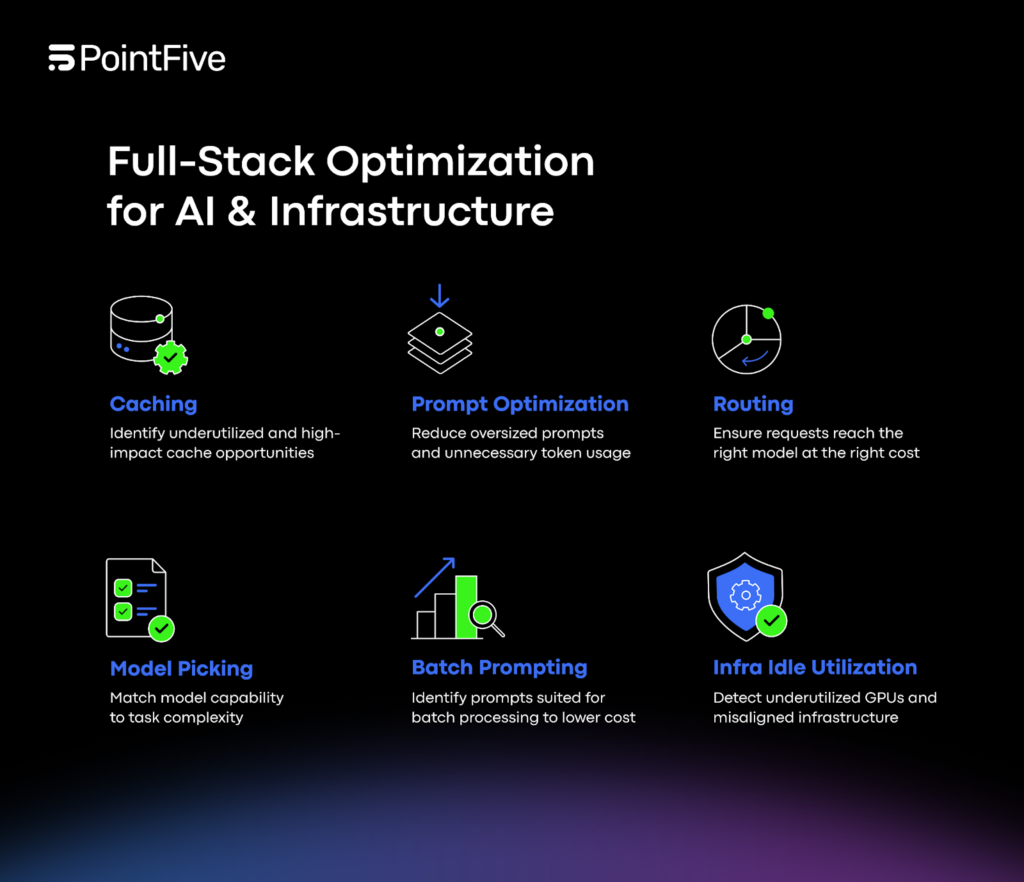
DeepWaste AI structures and enriches invocations with task classification, routing context, cost attribution, and infrastructure alignment signals, then detects inefficiency across four layers: Model & Routing Intelligence; Token & Prompt Economics; Caching & Reuse Optimization; and Infrastructure & Operational Leakage. PointFive lists examples including model-task mismatch and routing downgrade opportunities, prompt bloat and context window overprovisioning, duplicate inference detection and cache miss inefficiencies, and retry-driven cost inflation and provisioning misalignment.
PointFive emphasizes that detections are grounded in unified workload signals rather than surface-level billing anomalies, aiming for a behavioral view of how AI services operate.
From Findings to Measurable Remediation
DeepWaste AI is positioned as a tool for moving from detection to action. PointFive says each finding includes a quantified savings estimate and clear implementation guidance. Recommendations are prioritized by financial impact and mapped directly to engineering and FinOps workflows. Teams can evaluate projected savings before acting and track realized improvements over time, turning AI efficiency into a continuous, measurable discipline across models, infrastructure, and data platforms.
Now Available to PointFive Customers
“AI workloads introduce a new category of operational complexity,” said Alon Arvatz, CEO of PointFive. “DeepWaste AI gives organizations the intelligence required to scale AI efficiently, across models, infrastructure, and data platforms, without sacrificing control.”
DeepWaste AI is now available to PointFive customers.
