
New York City is one of the most well-served markets in the country for TMS treatment. The density of psychiatric practices, the presence of major academic medical centres, and the competitive landscape among providers mean that patients in New York have access to a range and quality of TMS care that is difficult to match elsewhere. That is a genuine advantage for patients. It also creates noise: not every practice offering TMS in New York is delivering the same standard of clinical care, and identifying which providers are worth your time requires a clear framework.
This guide is specifically oriented toward patients seeking TMS treatment in New York City. It covers what to look for, how to evaluate the specific dynamics of the NYC market, what the evidence says about TMS effectiveness, and how to approach the practical considerations that will shape your experience of treatment in this city.
For patients ready to begin their evaluation, Village TMS New York provides TMS and ketamine treatment in Manhattan with full psychiatric supervision and insurance support for qualifying patients.
The Evidence Behind TMS Treatment
Before evaluating specific providers, it is worth understanding the clinical evidence base that makes TMS worth seeking out in the first place. Transcranial magnetic stimulation was FDA-cleared for major depressive disorder in 2008 and has since accumulated a substantial body of clinical evidence.
Research published in peer-reviewed literature and indexed at the National Institutes of Health demonstrates that TMS produces clinically meaningful reductions in depression severity in patients who have not responded adequately to antidepressant medication, with response rates and remission rates that compare favourably to additional medication trials in treatment-resistant populations. The treatment has a favourable side effect profile, requires no sedation, and does not produce the systemic effects associated with medication changes.
More recent evidence has extended TMS’s indicated uses beyond depression. FDA clearances now cover OCD, anxious depression, and smoking cessation, and clinical research is ongoing for PTSD, ADHD, and other conditions. The New York academic medical community has contributed to this research base, and several NYC practices are involved in ongoing trials that may offer eligible patients access to emerging protocols.
Types of TMS Providers in New York City
The New York TMS market includes several distinct types of practices, each with different strengths and limitations:
Hospital-affiliated TMS programmes at major academic centres offer the strongest integration with broader psychiatric and medical care. Their academic affiliations mean exposure to the latest protocols and research participation opportunities. They can involve longer waiting times and more bureaucratic processes, and the patient experience may be less personalised than at smaller practices.
Independent outpatient psychiatric practices offering TMS typically provide more direct access to a treating psychiatrist and a more integrated approach to care. They are better positioned to offer combination treatments, such as TMS alongside ketamine or psychotherapy, and to adapt treatment as your clinical picture evolves.
Standalone TMS clinics offer high volume and technical efficiency but may lack the psychiatric depth to manage complex cases or to integrate TMS within a broader treatment plan. They can be appropriate for patients with straightforward presentations who have existing psychiatric care elsewhere, but are less suited to patients who need comprehensive management.
What Transcranial Magnetic Stimulation Actually Involves
Patients researching transcranial magnetic stimulation NYC sometimes want a clear explanation of what the treatment physically involves before committing to a consultation. The experience is straightforward.
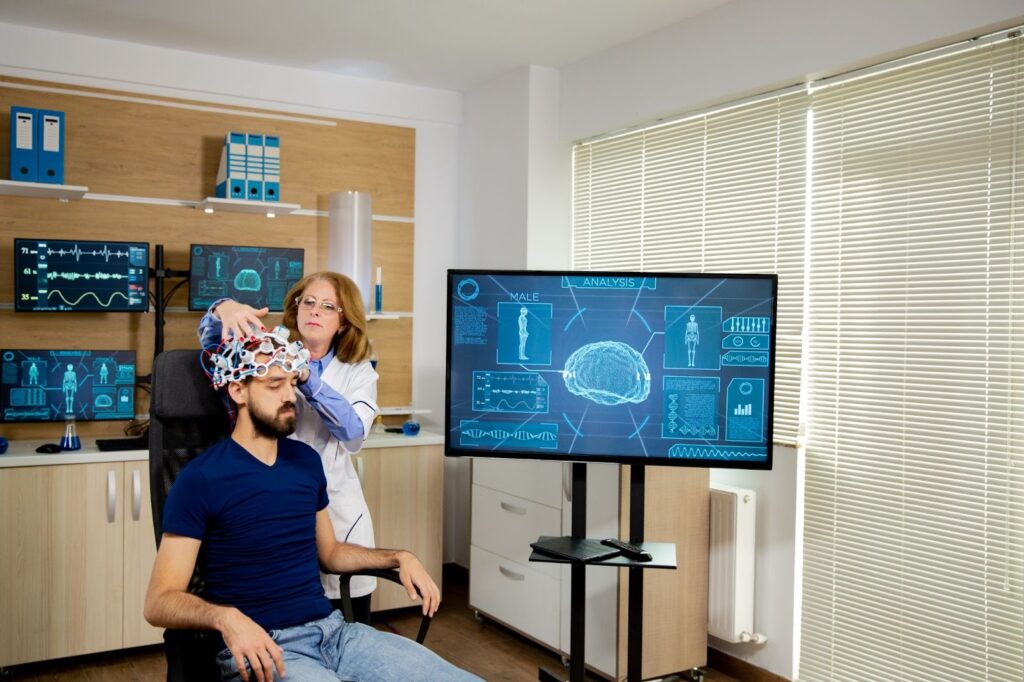
You sit in a chair, fully awake and alert, while a trained technician positions a magnetic coil against a specific location on your scalp. The coil delivers rapid magnetic pulses that create small electrical currents in the targeted brain region. For depression, the most common target is the left dorsolateral prefrontal cortex, which shows reduced activity in depression and which TMS aims to normalise.
The sensation during treatment is a series of clicks and a tapping or pecking feeling on the scalp at the treatment site. Most patients find this mildly uncomfortable at first, particularly over the first few sessions, but it is not painful and the discomfort typically reduces significantly as the brain habituates to the stimulation. No anaesthesia or sedation is required, and you can return to normal activities, including driving, immediately after each session.
Standard sessions last between 20 and 40 minutes depending on the protocol. Theta burst stimulation, a newer and equally effective protocol, can complete a session in as little as three minutes. Acute treatment courses typically involve daily sessions five days a week for four to six weeks, for a total of 20 to 30 sessions.
Key Criteria for Evaluating NYC TMS Providers
- Direct psychiatric involvement: the psychiatrist overseeing your care should have personally evaluated you, be accessible throughout the treatment course, and be actively monitoring your response, not simply reviewing session logs at a distance
- Insurance experience with New York payers: Aetna, Cigna, Empire BlueCross, UnitedHealthcare, Oscar Health, and others each have specific prior authorisation requirements. A practice experienced with these payers navigates your coverage more efficiently than one with limited New York insurance experience
- FDA-cleared equipment and protocol range: ask which TMS system the practice uses, whether it is FDA-cleared, and whether they offer standard TMS, theta burst stimulation, and deep TMS. The ability to select and adjust protocols based on your clinical response is a marker of a serious clinical operation
- Location and scheduling: daily sessions for four to six weeks make logistics genuinely important. A clinic close to your home or workplace, with scheduling flexibility, is a clinical consideration as much as a practical one, since incomplete treatment courses are one of the main reasons patients don’t achieve full benefit
- Combination treatment capability: the best NYC practices offer TMS, ketamine, and psychotherapy within the same clinical framework, or have strong referral relationships that allow genuine coordination between providers
Insurance and Cost in New York
Most major commercial insurance plans cover TMS for major depressive disorder in patients who meet clinical criteria, which typically require documented failure of at least two antidepressant medications. Medicare Part B covers TMS under similar criteria. A clinic with dedicated insurance staff will manage the prior authorisation process on your behalf, which is one of the most practically important things to verify before choosing a provider.
In New York’s competitive market, out-of-pocket pricing for patients without insurance coverage or with out-of-network plans has become more accessible than it was in earlier years. Ask for a clear breakdown of costs before you commit, and confirm what is included in the quoted price.
Final Thoughts
New York City offers patients seeking TMS treatment some of the most experienced and well-resourced providers available anywhere in the country. The challenge is identifying which practices are delivering on the promise of quality care rather than simply operating at volume in a high-demand market.
The evaluation criteria outlined here, applied consistently during your search, will help you navigate the NYC TMS landscape and find a practice where you can receive treatment with the clinical rigour and personalised attention that gives you the best chance of a meaningful, lasting response.
