
How to write vendor requirements for routes, placement, servicing, and rapid response so “ADA ready” means usable
Temporary restroom accessibility usually fails for one reason: the contract buys a unit, but it does not buy a deployment. The vendor delivers what was ordered, the site team deals with what was missed, and the public experiences the result. If you want accessible portable restrooms to be usable in real conditions, your scope has to specify the operational realities that make access work.
This article is for event organizers, municipal buyers, campuses, general contractors, and site managers who are tired of vague language, surprise complaints, and last-minute fixes. The goal is simple: write scope requirements that make the plan real before the truck arrives.
Start with the truth: accessibility is a system, not a SKU
A portable unit can be labeled accessible and still fail if the route is unstable, the door zone is blocked, or the unit becomes unusable during peak traffic. Planning guidance consistently points to the same usability concepts: clear space, turning space, door maneuvering clearance, stable approaches, and practical site planning.
For baseline standards language, planners often reference the 2010 ADA Standards for Accessible Design. For practical restroom planning guidance, the U.S. Access Board toilet room guide is a useful translation tool: ADA guide for toilet rooms and portable units.
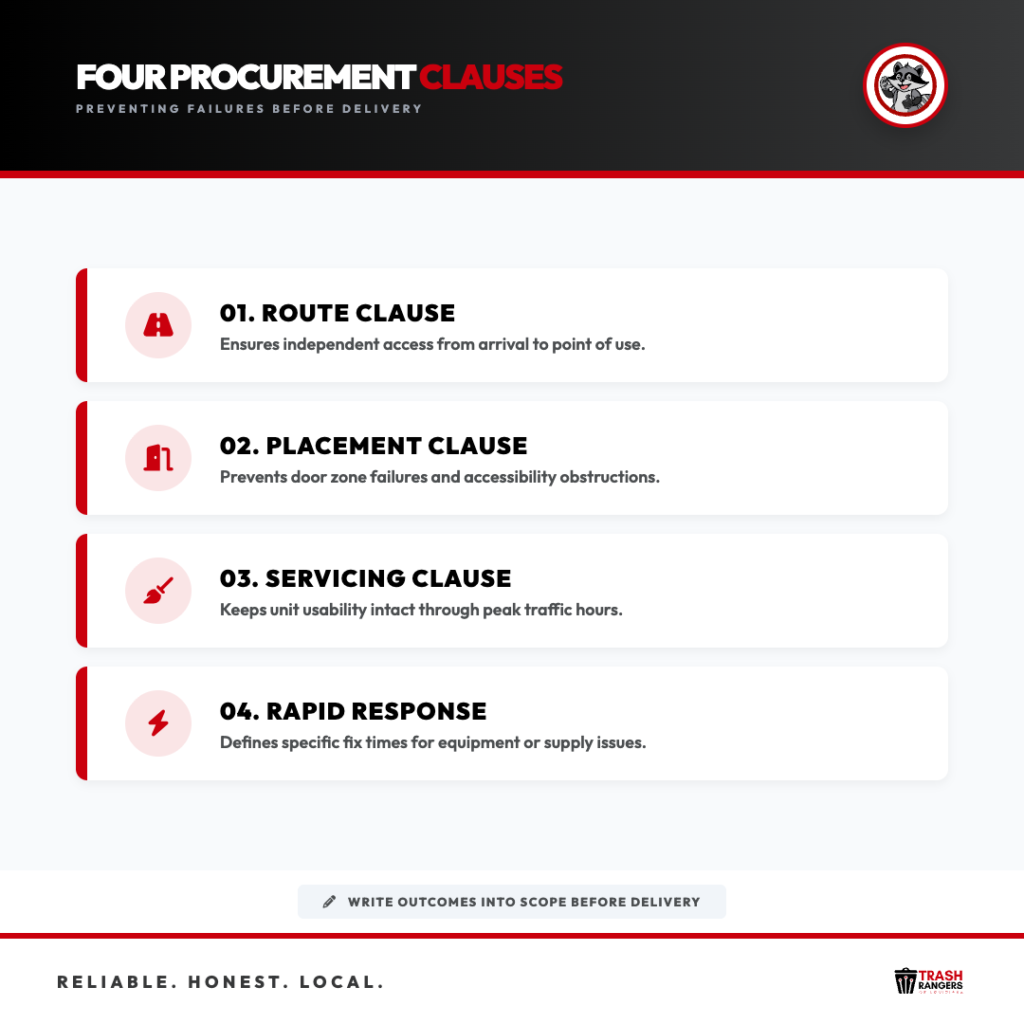
The four clauses that prevent most field failures
If you only add four things to your scope, add these. They map directly to the most common failures.
1) Route clause: define the approach, not just the location
Problem it prevents: “The ADA unit is there, but nobody can reach it independently.”
Scope language to use:
- The vendor and organizer will confirm an accessible approach route from primary circulation paths to each restroom cluster before delivery.
- Approach route must remain clear of temporary barriers, queue rails, vendor lines, and equipment staging.
- If ground conditions are unstable (mud, loose gravel, or deep grass), the organizer will provide a stable surface treatment (matting, panels, or compacted base), and the vendor will confirm placement on the treated area.
- Signage locations will be identified at decision points directing attendees to accessible restrooms.
2) Placement clause: specify stable ground and door zone clearance
The problem it prevents: “The unit is accessible inside but useless at the door.”
Scope language to use:
- Accessible units must be placed on stable, level ground to prevent threshold tilt and door binding.
- A clear door zone must be maintained. No trash cans, stanchions, barricades, or stored materials may block the door swing or the area directly in front of the entrance.
- Accessible units may not be placed behind fencing pinch points or within narrow corridors created by barricades.
3) Servicing clause: treat cleaning and restocking as accessibility
Problem it prevents: “The unit was usable at 9 AM and unusable by noon.”
Scope language to use:
- Vendor will provide a service plan aligned to expected attendance and peak traffic periods.
- Service includes cleaning, restocking paper products, and confirming the accessible unit remains functional and clear of interior obstructions.
- Organizer and vendor will identify peak hours in advance and schedule service windows accordingly.
4) Rapid response clause: define what happens when something fails
Problem it prevents: “We reported an issue and nobody showed up.”
Scope language to use:
- Vendor will provide a rapid-response contact for event-day failures affecting accessible units.
- Vendor will respond within an agreed time window for urgent issues that reduce usability (door hardware failure, significant contamination, unit damage, blocked access due to placement drift).
- The organizer will provide access to service vehicles in a manner consistent with site security protocols.
Stop isolating the accessible unit.
One of the most common procurement failures is unintentional isolation. When an accessible unit is placed far from the main restroom bank, it becomes harder to find, harder to service, and more likely to be blocked or misused. Your scope should explicitly require that accessible units be integrated into restroom clusters.
Scope language to use: Accessible units must be located within the same restroom cluster as standard units, unless site constraints require an alternative placement approved in writing by the organizer.
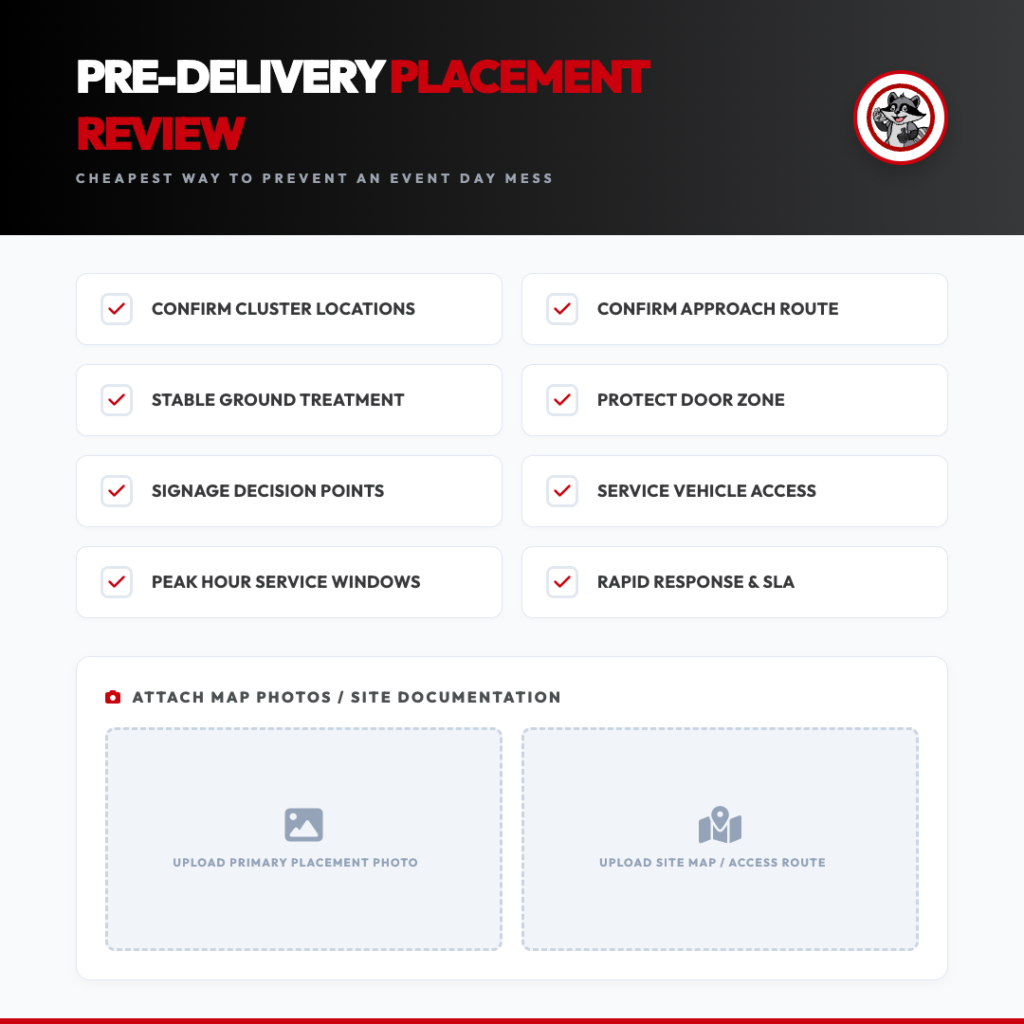
Use a pre-delivery walk: the cheapest way to prevent a mess
The simplest operational fix is a short, documented pre-delivery walk. It forces alignment on route, ground conditions, door zone, and service access. Without it, teams tend to “assume,” and assumptions break during setup.
Scope language to use: The vendor and organizer will conduct a pre-delivery placement review (in person or via shared map and photos) to confirm cluster locations, approach routes, stable ground treatments, and service access.
Baton Rouge signal: features are rising, but scopes must keep up
In February 2026, Baton Rouge-based provider Trash Rangers announced ADA-compliant portable toilet rentals for event organizers and job sites, emphasizing step-free entry, a reinforced flat floor, interior space for maneuvering, heavy-duty handrails, and scheduled local maintenance.
Use this coverage link in your placement or reference list: Trash Rangers ADA portable toilet rentals in Baton Rouge.
That kind of offering reflects upward demand. The procurement lesson is simple: do not buy the label and hope. Buy the deployment plan and measure the outcome.
Copy and paste the scope block.
If you want a single block you can drop into a vendor agreement, start here and adjust for your site:
Accessible Portable Restroom Requirements: Vendor will provide accessible portable toilet units and coordinate placement with the organizer. Organizer and vendor will confirm an accessible approach route from primary circulation paths to each restroom cluster before delivery. Accessible units will be placed on stable, level ground with a clear door zone kept free of barriers, trash cans, stanchions, or stored materials. Accessible units will be integrated into restroom clusters unless site constraints require an alternate placement approved by the organizer. Vendor will provide a servicing plan aligned with expected attendance and peak traffic periods, including cleaning and restocking, and will maintain a rapid-response contact for event-day issues affecting usability.
The takeaway
Temporary restroom accessibility is what happens after the truck leaves. If you want it to work, your scope has to describe routes, placement, service, and response with the same clarity you use for power, security, and waste. Otherwise, you are buying a word and hoping it turns into an experience.
